
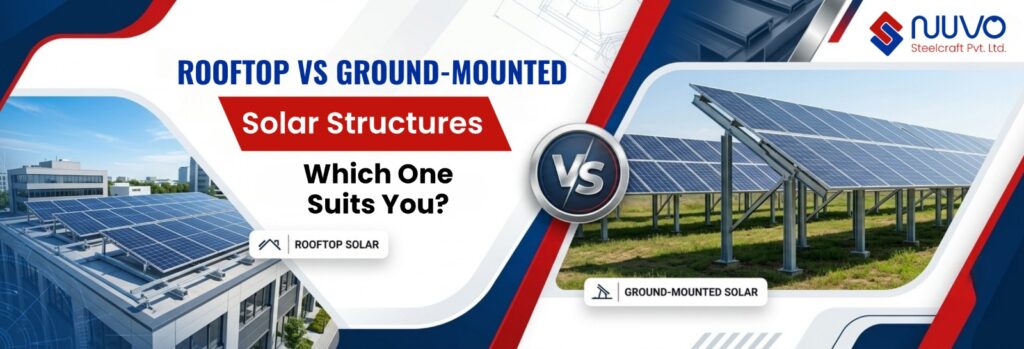
As solar energy adoption continues to grow across residential, commercial and industrial sectors, choosing between a rooftop vs ground-mounted solar structure is one of the most important decisions before starting a solar project. While solar panels receive most of the attention, the supporting structure plays a major role in system efficiency, durability, maintenance requirements and long-term performance. The right choice depends on available space project size energy goals budget and site conditions. Understanding the strengths and limitations of both options helps property owners make a well-informed investment that delivers reliable energy for decades.
Whether you are planning a rooftop installation for an office building or a large ground-mounted solar farm, selecting the appropriate structure ensures maximum energy generation while maintaining safety and structural integrity. This guide compares both systems in detail to help you determine which solution best fits your project requirements.
Why the Solar Mounting Structure Matters
A solar mounting structure is the backbone of every solar power system. It securely supports the solar panels while keeping them positioned at the ideal angle to capture maximum sunlight.
A high-quality mounting structure provides several benefits.
- Ensures long-term stability
- Protects panels against environmental stress
- Improves energy production
- Simplifies maintenance
- Increases the lifespan of the solar installation
- Supports safe operation during varying weather conditions
Choosing between rooftop and ground-mounted structures is not simply about available space. It requires evaluating technical performance, installation conditions, future expansion and lifecycle costs.
Understanding Rooftop Solar Mounting
Rooftop solar mounting systems are installed directly on the roof of a building. They are widely used for homes, offices, factories, schools, hospitals, warehouses and commercial complexes where roof space is available.
The structure is attached securely to the building using engineered fastening systems while maintaining proper panel alignment and load distribution.
Advantages of Rooftop Solar Mounting
Efficient Use of Existing Space
Since the system utilizes available roof space there is no need for additional land acquisition. This makes rooftop installations highly practical in urban areas where land availability is limited.
Lower Civil Construction Requirements
Unlike ground-mounted systems, rooftop installations usually require less site preparation, which helps reduce overall project complexity.
Reduced Land Costs
Property owners can generate solar power without sacrificing valuable ground space for other business or residential activities.
Shorter Cable Runs
Because the panels are closer to the electrical infrastructure, rooftop systems often require shorter wiring distances, which helps minimize transmission losses.
Faster Project Completion
Most rooftop installations can be completed more quickly because they involve fewer earthwork activities compared to ground-mounted projects.
Challenges of Rooftop Solar Mounting
Despite their advantages, rooftop systems also have certain limitations.
- Roof load capacity must be carefully evaluated.
- Roof orientation may not always provide optimal sunlight exposure.
- Maintenance access can be more restricted.
- Future building modifications may become more complex.
- Installation depends on the roof condition and structural health.
Professional structural assessment is essential before installing rooftop solar systems.
Companies like Nuvo Steelcraft manufacture engineered mounting solutions that are designed to optimize rooftop safety, durability and installation efficiency.
Understanding Ground Mount Solar Structure
A ground-mount solar structure is installed directly on land using specially designed foundations that support solar panels independently of nearby buildings.
These systems are commonly used for utility-scale solar farms, industrial facilities, institutions, agricultural projects and locations with sufficient open land.
Ground-mounted systems offer greater flexibility in panel orientation and layout, making them ideal for maximizing energy generation.
Advantages of Ground Mount Solar Structure
Maximum Sunlight Exposure
Ground-mounted systems can be positioned at the ideal tilt and orientation to capture the highest possible amount of sunlight throughout the year.
Easier Maintenance
Technicians have convenient access to panels, electrical components and structural connections, making inspection and cleaning significantly easier.
Better Cooling Performance
Panels installed above ground generally experience better airflow, which helps improve operating efficiency during hot weather.
Greater Expansion Opportunities
Ground-mounted projects can often be expanded more easily if future energy demand increases.
Flexible System Design
Large open spaces allow engineers to optimize spacing, tilt angles and row orientation for improved performance.
Challenges of Ground-Mounted Systems
Ground-mounted installations also involve certain considerations.
- Land availability becomes a primary requirement.
- Site preparation increases project scope.
- Civil foundation work adds construction time.
- Longer cable routes may increase installation costs.
- Vegetation management may be required throughout system’s life.
Although these projects often require higher initial investment, they provide significant advantages for large-scale solar generation.
Comparing Structure Cost
One of the most common questions among project owners relates to structure cost.
The total investment depends on multiple technical factors rather than simply choosing rooftop or ground-mounted systems.
Rooftop Structure Cost
Rooftop systems generally involve:
- Lower foundation expenses
- Reduced land development costs
- Less excavation work
- Faster installation
- Lower transportation requirements
However, structural reinforcement may become necessary if the building cannot support the additional load.
Ground-Mounted Structure Cost
Ground-mounted systems usually include:
- Foundation construction
- Site grading
- Land preparation
- Additional steel requirements
- Longer electrical cable installation
Although the initial investment may be higher, ground-mounted systems often deliver greater long-term flexibility and energy output.
The right decision should consider total lifecycle value rather than upfront installation cost alone.
Design Factors That Influence the Right Choice
Several design factors determine whether rooftop or ground-mounted solar structures are more suitable for a project.
Available Space
This is often the deciding factor.
Buildings with large unused rooftops naturally favour rooftop installations, while projects with abundant open land may benefit from ground-mounted systems.
Energy Requirements
Large industrial facilities requiring substantial power generation may exceed available rooftop capacity, making ground-mounted systems a better solution.
Smaller commercial buildings often meet their energy needs through rooftop installations.
Structural Capacity
For rooftop projects, engineers must verify that the building can safely support:
- Solar panel weight
- Mounting structure
- Wind loads
- Maintenance personnel
If structural limitations exist, ground-mounted systems may become the preferred option.
Sunlight Availability
Nearby buildings, trees, water tanks and other rooftop equipment may create shading that reduces energy production.
Ground-mounted systems allow greater flexibility to avoid shading and maximize sunlight exposure.
Future Expansion
Businesses expecting future growth should evaluate whether additional solar capacity may be required.
Ground-mounted systems usually provide more flexibility for future expansion than rooftop installations.
Maintenance Accessibility
Easy maintenance helps maintain long-term energy production.
Ground-mounted installations generally provide simpler access for:
- Cleaning
- Inspection
- Repairs
- Component replacement
Environmental Conditions
Wind speed, rainfall, temperature fluctuations, soil conditions and corrosion exposure all influence structural design.
Every project requires engineering calculations based on local environmental conditions before selecting the appropriate mounting solution.
Performance Comparison
When comparing overall performance, both systems can deliver excellent results if designed correctly.
Rooftop Systems Perform Well When
- Roof orientation is favourable.
- Structural capacity is sufficient.
- Shading is minimal.
- Available roof space matches energy demand.
Ground Mounted Systems Perform Well When
- Maximum energy generation is the primary objective.
- Large land areas are available.
- Future expansion is planned.
- Panel orientation requires greater flexibility.
Proper engineering has a greater influence on performance than installation location alone.
Which Industries Prefer Rooftop Solar?
Rooftop solar installations are widely adopted by:
- Manufacturing facilities
- Office buildings
- Educational institutions
- Hospitals
- Shopping centers
- Hotels
- Warehouses
These buildings often possess large roof areas capable of supporting commercial solar installations.
Which Industries Prefer Ground-Mounted Solar?
Ground-mounted systems are commonly selected for:
- Solar farms
- Agricultural operations
- Industrial campuses
- Government infrastructure
- Airports
- Large institutions
- Manufacturing plants with surplus land
These projects often require higher generation capacity than rooftops can accommodate.
Choosing the Right Structural Manufacturer
The quality of the mounting structure directly affects the long-term safety and reliability of the solar system.
Before selecting a supplier, consider the following.
Engineering Expertise
Choose manufacturers with experience in structural design rather than simply steel fabrication.
Material Quality
High-quality galvanized steel and corrosion-resistant components improve durability.
Wind Load Engineering
Structures should be designed to withstand local wind conditions using recognized engineering standards.
Precision Manufacturing
Accurate fabrication simplifies installation while improving structural performance.
Technical Support
Reliable manufacturers provide engineering guidance throughout the project lifecycle.
Nuvo Steelcraft develops engineered solar mounting solutions designed to meet demanding commercial and industrial project requirements. By combining precision manufacturing with quality materials, the company supports dependable solar infrastructure across a wide range of applications.
Common Mistakes to Avoid
Many project owners focus only on solar panels while overlooking structural planning.
Avoid these common mistakes.
Selecting Based Only on Initial Price
The lowest-cost option may increase maintenance and replacement expenses over time.
Ignoring Structural Engineering
Every installation requires proper engineering calculations before construction begins.
Underestimating Wind Loads
Environmental forces significantly affect long-term structural performance.
Overlooking Future Expansion
Planning for future energy requirements helps avoid expensive modifications later.
Choosing Generic Designs
Every project has unique site conditions that require customized structural solutions.
Which Option Is Right for You?
The best choice depends on your project objectives.
Choose rooftop solar mounting if:
- You have sufficient roof space.
- Land availability is limited.
- Building structure supports solar installation.
- Energy requirements match rooftop capacity.
- Faster installation is preferred.
Choose a ground mount solar structure if:
- Large land areas are available.
- Maximum energy generation is the priority.
- Future expansion is expected.
- Maintenance accessibility is important.
- The building cannot support rooftop loads.
There is no universal solution. The right decision always depends on engineering analysis, project requirements and long-term operational goals.
Why Structural Quality Should Never Be Compromised
Whether installing rooftop or ground-mounted systems, the mounting structure must provide reliable performance throughout the lifespan of the solar project.
A high-quality structure offers:
- Greater durability
- Improved safety
- Better corrosion resistance
- Reduced maintenance
- Consistent panel alignment
- Long-term return on investment
Working with experienced manufacturers such as Nuvo Steelcraft ensures that structural design, material quality and manufacturing precision align with the performance expectations of modern solar installations.
Conclusion
Choosing between a rooftop vs ground-mounted solar structure requires careful evaluation of available space, project size, energy requirements, environmental conditions and long-term business goals. Both systems offer distinct advantages when designed and installed correctly.
Rooftop solar mounting provides an efficient solution for buildings with available roof space, while a ground mount solar structure offers greater flexibility, scalability and optimized energy generation for larger projects. Comparing structure cost alongside key design factors helps property owners make informed decisions that balance performance, durability and long-term value.
For commercial and industrial solar projects, the quality of the mounting system is just as important as the solar panels themselves. Nuvo Steelcraft delivers precision-engineered solar mounting solutions that combine structural strength, corrosion resistance and reliable performance. With a strong focus on engineering excellence, Nuvo Steelcraft helps businesses build solar infrastructure that remains safe, efficient and dependable for years to come.