
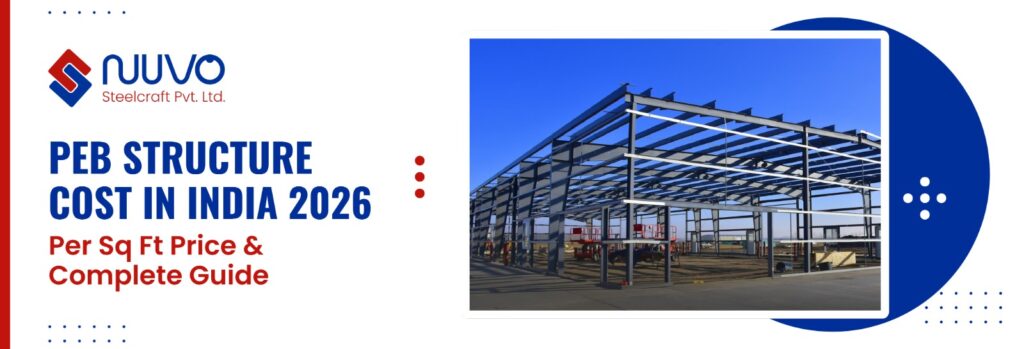
The demand for modern, cost-efficient, and scalable construction solutions in India is rising rapidly. Industries such as manufacturing, warehousing, logistics, and infrastructure are shifting towards faster and more reliable building methods.
One of the most preferred solutions today is pre-engineered buildings (PEB). However, before making an investment decision, understanding the PEB structure cost in India is essential.
This guide provides a detailed breakdown of PEB cost per sq ft, key cost factors, and how it compares with traditional construction methods in 2026.
What is a PEB Structure
A pre-engineered building is a steel structure designed and fabricated in a factory and then assembled at the construction site. Unlike traditional construction, PEB systems use optimised steel components and modular designs to reduce time, cost, and material wastage.
These structures are widely used for industrial sheds, warehouses, factories, logistics parks, and commercial buildings due to their efficiency and flexibility.
PEB Structure Cost in India 2026
The PEB structure cost in India varies depending on multiple factors such as design, materials, size, and location. However, to give a general estimate:
Average PEB Cost Per Sq Ft in India (2026)
- Basic PEB structure: ₹1,200 to ₹1,800 per sq ft
- Standard industrial building: ₹1,800 to ₹2,500 per sq ft
- High-end or customized PEB: ₹2,500 to ₹3,500+ per sq ft
These costs typically include structural steel, fabrication, and erection. However, additional elements such as flooring, insulation, electrical work, and interiors may increase the overall cost.
Understanding the PEB cost per sq ft helps businesses plan budgets more accurately and compare different construction options.
Factors Affecting Pre-Engineered Building Cost 2026
The cost of a PEB project is not fixed. It depends on several critical parameters that influence the final pricing.
1. Building Size and Span
Larger buildings generally have a lower cost per sq ft due to economies of scale. However, wider spans without columns may require additional steel, increasing the cost.
2. Steel Price Fluctuations
Steel is the primary material used in PEB structures. Any fluctuation in steel prices directly impacts the overall cost.
In 2026, steel pricing continues to be a major factor influencing steel building costs in India.
3. Design Complexity
Simple rectangular structures are more cost-effective compared to complex designs with multiple elevations, mezzanine floors, or architectural features.
4. Roofing and Cladding Materials
The choice of roofing sheets, insulation, and wall cladding significantly affects pricing.
Options such as insulated panels, colour-coated sheets, and specialised coatings increase costs but improve performance and durability.
5. Location and Site Conditions
Transportation costs, labour availability, and site accessibility influence the final project cost.
Remote or challenging locations may require additional logistics and foundation work.
6. Foundation and Civil Work
Although PEB structures are lighter than RCC, foundation costs still play an important role.
Soil conditions, load requirements, and building height determine the type and cost of foundation.
7. Additional Features
Costs may increase based on additional requirements such as:
- Mezzanine floors
- Crane systems
- Ventilation and insulation
- Fire safety systems
- Office spaces within the structure
These elements are commonly included in industrial shed cost calculations.
Detailed Breakdown of Industrial Shed Cost
For industrial applications, understanding the cost distribution is essential.
Key Cost Components
- Structural steel framework
- Roofing and wall cladding
- Fabrication and erection
- Civil foundation work
- Flooring and finishing
- Electrical and plumbing systems
Typically, the structural component accounts for 50 to 60 percent of the total cost, while the remaining cost depends on customisation and finishing requirements.
PEB vs RCC Cost Comparison
When comparing the pre-engineered building cost in 2026 with traditional RCC construction, the difference becomes evident.
PEB Construction
- Lower construction time
- Reduced labor costs
- Minimal material wastage
- Faster return on investment
- Cost-effective for large-span structures
RCC Construction
- Higher material and labor costs
- Longer construction timelines
- Increased overhead expenses
- Less flexibility for expansion
On average, PEB construction can be 20 to 30 percent more cost-efficient than RCC for industrial applications.
Why PEB is Cost-Effective for Industrial Projects
The cost advantages of PEB structures go beyond initial construction.
Faster Completion Reduces Costs
Shorter project timelines reduce labour costs, site expenses, and financing costs.
Optimised Material Usage
Advanced engineering ensures that steel is used efficiently, minimising wastage.
Lower Maintenance Costs
PEB structures require less maintenance compared to traditional buildings, reducing long-term expenses.
Better Space Utilisation
Clear-span designs maximise usable area, improving operational efficiency without increasing cost.
Steel Building Cost India – Long-Term Value
While evaluating steel building cost in India, it is important to consider long-term value rather than just initial investment.
Steel structures offer:
- High durability and strength
- Resistance to environmental factors
- Easy modification and expansion
- Recyclability and sustainability
These factors make PEB structures a smart investment for industries planning long-term operations.
Cost Optimisation Tips for PEB Projects
Businesses can reduce costs further by following strategic planning and design practices.
Choose Standard Designs
Opting for simple and standard designs reduces fabrication complexity and cost.
Plan for Future Expansion
Designing the structure with future expansion in mind avoids costly modifications later.
Select the Right Materials
Balancing cost and quality in roofing, cladding, and insulation helps optimise overall expenses.
Work with Experienced Contractors
Choosing a reliable company ensures efficient execution, accurate cost estimation, and minimal delays.
When is PEB the Right Choice
PEB structures are ideal for:
- Warehouses and logistics hubs
- Manufacturing units and factories
- Industrial sheds
- Commercial industrial spaces
- Large-span structures
For these applications, PEB offers the best combination of cost efficiency, speed, and scalability.
Future of PEB Construction in India
The adoption of PEB is expected to grow significantly in 2026 and beyond.
Key trends driving this growth include:
- Increasing demand for industrial infrastructure
- Expansion of e-commerce and logistics
- Rising construction costs in traditional methods
- Focus on sustainable and efficient building solutions
As industries continue to prioritise speed and cost control, PEB is becoming the preferred construction method across India.
Conclusion
Understanding the PEB structure cost in India is essential for making informed construction decisions. While the PEB cost per sq ft may vary depending on design and requirements, it consistently offers better value compared to traditional construction methods.
From reduced timelines and lower costs to flexibility and long-term durability, PEB structures provide a comprehensive solution for modern industrial needs.
Whether you are planning a warehouse, factory, or industrial shed, investing in a pre-engineered building ensures efficiency, scalability, and cost-effectiveness.
Partnering with an experienced company like Nuvo Steelcraft allows you to benefit from expert design, high-quality materials, and seamless project execution, ensuring that your investment delivers maximum value.