
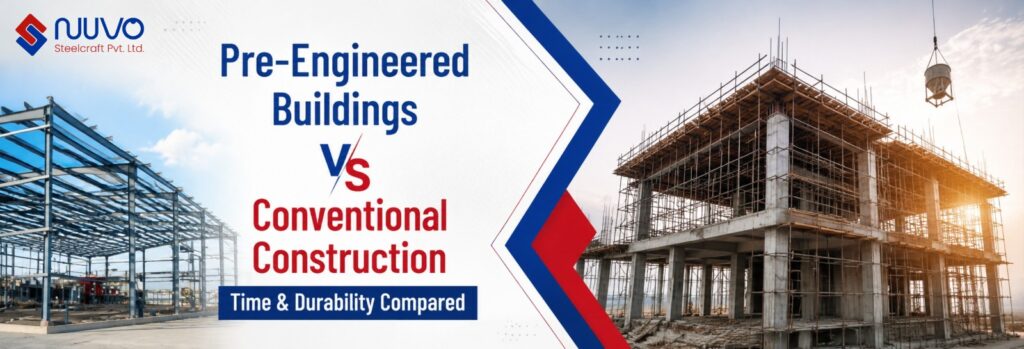
The construction industry has undergone a significant transformation over the past two decades. As businesses seek faster project delivery, cost efficiency, structural reliability and long-term performance, traditional construction methods are increasingly being compared with modern alternatives such as pre-engineered buildings. From manufacturing facilities and logistics centres to warehouses, industrial sheds, commercial buildings and infrastructure projects, organisations are evaluating which construction approach provides the greatest value.
The debate between pre-engineered buildings in India and conventional construction has become especially relevant in sectors where time, scalability and operational efficiency directly impact profitability. While conventional construction has served industries for generations, pre-engineered building systems are rapidly gaining popularity due to their speed, precision and adaptability.
For project developers, factory owners, warehouse operators and industrial investors, understanding the differences between these two construction approaches is critical. Factors such as project timelines, durability, maintenance requirements, expansion flexibility and overall lifecycle costs all influence the decision-making process.
In this blog, we compare pre-engineered buildings and conventional construction in detail, focusing on time efficiency, durability, cost implications and long-term performance to help businesses make informed construction decisions.
Understanding Conventional Construction
Conventional construction refers to traditional building methods that primarily utilise reinforced concrete, masonry, brickwork, cast-in-place structural elements and on-site fabrication processes.
In conventional construction, most structural components are manufactured, assembled and installed directly at the project site. Activities such as foundation work, reinforcement placement, shuttering, concrete pouring, curing, masonry and structural assembly occur sequentially over an extended period.
This method has been widely used across residential, commercial and industrial sectors because of its familiarity and adaptability. Conventional construction allows architects and engineers considerable design flexibility and has a long-established history of implementation.
However, traditional construction often requires substantial labor, longer execution timelines and extensive site management. Project delays caused by weather conditions, labour shortages, material availability and coordination challenges are relatively common.
As industries demand faster project completion and improved operational efficiency, alternative construction methods are becoming increasingly attractive.
What Are Pre-Engineered Buildings?
Pre-engineered buildings, commonly known as PEBs, are steel structures designed, engineered, fabricated and partially assembled in controlled manufacturing environments before being transported to the project site for installation.
Unlike conventional construction, where most structural activities occur on-site, pre-engineered building systems involve extensive off-site fabrication. Components are manufactured according to precise engineering specifications and then assembled rapidly at the construction location.
The concept of pre-engineered buildings in India has gained significant traction due to its ability to accelerate project timelines while maintaining structural quality and performance.
PEBs are commonly used for:
- Industrial facilities
- Warehouses
- Manufacturing plants
- Logistics centers
- Distribution hubs
- Commercial buildings
- Aircraft hangars
- Agricultural structures
- Institutional facilities
The increasing demand for efficient industrial infrastructure has contributed to the widespread adoption of pre-engineered construction solutions.
Why Industries Are Shifting Toward Steel Structures
The modern industrial environment requires buildings that can be constructed quickly, expanded easily and maintained efficiently.
This demand has encouraged businesses to work with experienced steel structure manufacturer companies capable of delivering customised solutions that align with operational requirements.
Steel offers several advantages over traditional construction materials. It provides high strength-to-weight ratios, excellent structural performance, dimensional accuracy and design flexibility.
As industrial operations become more dynamic, businesses increasingly prefer structures that can adapt to changing production requirements, storage capacities and technological advancements.
Steel-based construction systems support this flexibility while reducing overall project complexity.
Time Comparison: Pre-Engineered Buildings vs Conventional Construction
One of the most significant differences between the two approaches is project execution speed.
In conventional construction, activities generally follow a sequential workflow. Foundation work must be completed before structural elements can be constructed. Concrete curing periods introduce additional delays and multiple trades often depend on the completion of previous activities before proceeding.
As a result, large industrial projects can require many months or even years to complete.
By contrast, pre-engineered buildings in India significantly reduce construction timelines through parallel processes. While foundations are being prepared on-site, structural components are simultaneously fabricated in manufacturing facilities.
Once fabrication is complete, components are transported to the site and assembled rapidly using bolted connections and efficient installation techniques.
This parallel workflow often reduces overall project duration by 30% to 50% or more, depending on project complexity.
For businesses where operational readiness directly impacts revenue generation, faster construction can provide substantial competitive advantages.
How Faster Construction Impacts Business Operations
Construction speed is not merely a scheduling benefit, it has direct financial implications.
Industrial facilities generate value only after becoming operational. Delayed project completion can postpone manufacturing activities, warehousing operations, logistics services and revenue generation.
Faster project delivery enables organisations to begin operations sooner, improving return on investment and reducing opportunity costs.
This is one of the key reasons why companies increasingly evaluate PEB construction cost alongside project timelines rather than focusing solely on initial construction expenses.
The ability to accelerate occupancy and operational readiness often contributes significantly to overall project value.
Durability Comparison Between PEB and Conventional Structures
Durability is another major factor influencing construction decisions.
Conventional buildings constructed with reinforced concrete can provide excellent long-term performance when properly designed and maintained. However, issues such as cracking, moisture penetration, corrosion and deterioration may develop over time if maintenance is neglected.
Modern pre-engineered steel structures are designed to withstand demanding environmental conditions while maintaining structural integrity over extended periods.
Protective coatings, advanced fabrication technologies and precision manufacturing processes contribute to improved durability and corrosion resistance.
When engineered correctly, steel structures can achieve service lives comparable to conventional buildings while offering additional advantages related to maintenance and adaptability.
The durability of a structure ultimately depends on design quality, material selection, environmental conditions and maintenance practices.
Structural Performance and Engineering Precision
One of the defining characteristics of pre-engineered buildings is engineering precision.
Every component is designed using advanced structural analysis software and manufactured according to strict quality standards. This reduces inconsistencies that can occur during on-site construction.
Working with a reputable PEB manufacturer in Maharashtra allows project owners to benefit from highly optimised structural systems that maximise performance while minimising material consumption.
Conventional construction can also achieve excellent structural performance but on-site variability often introduces additional quality control challenges.
Factory-based fabrication enables tighter tolerances, better quality assurance and more consistent outcomes.
This level of precision contributes significantly to the growing popularity of pre-engineered solutions.
Cost Considerations: Understanding PEB Construction Cost
Many project owners initially focus on construction cost when comparing building methods.
The evaluation of PEB construction cost should include more than just material and installation expenses. Total project economics involve several factors:
- Construction timeline
- Labor requirements
- Material efficiency
- Maintenance costs
- Expansion flexibility
- Operational readiness
- Lifecycle value
Pre-engineered buildings often reduce labour costs due to simplified installation procedures. Material optimisation also contributes to cost efficiency because structural members are designed specifically for anticipated loads.
Additionally, shorter construction periods reduce indirect expenses related to project management, equipment rentals and financing.
When evaluated from a lifecycle perspective, PEBs frequently provide strong economic advantages.
Flexibility in Industrial Building Design
Modern industries require facilities that can evolve alongside business growth.
Effective industrial building design must accommodate changing production processes, storage requirements, equipment upgrades and future expansion opportunities.
Pre-engineered buildings offer exceptional flexibility in this regard. Clear-span designs allow large unobstructed spaces that can be reconfigured as operational needs change.
Expansions can often be implemented more efficiently than in conventional structures because modular systems are designed with adaptability in mind.
Businesses seeking long-term operational flexibility often view this as one of the most important steel building advantages.
Prefab Warehouses and Logistics Infrastructure
The rapid growth of e-commerce, logistics and supply chain operations has significantly increased demand for prefab warehouse solutions.
Warehouses require large open spaces, rapid construction, scalability and efficient material handling environments.
Pre-engineered building systems are particularly well-suited for warehouse applications because they provide:
- Large clear spans
- Fast installation
- Structural efficiency
- Expansion capability
- Cost-effective construction
As logistics networks continue expanding across India, prefab warehouses are becoming a preferred solution for developers and operators seeking operational efficiency.
This trend has contributed substantially to the growth of the PEB industry.
Maintenance Requirements Over Time
Maintenance costs play an important role in lifecycle economics.
Conventional buildings may require periodic repairs related to cracking, waterproofing, structural deterioration and surface maintenance.
Modern steel buildings utilize protective treatments and coatings that reduce maintenance requirements while enhancing durability.
Routine inspections and preventive maintenance remain important for both construction methods. However, properly designed steel structures often offer predictable maintenance profiles and simplified upkeep procedures.
Lower maintenance demands contribute to improved long-term value.
Sustainability and Environmental Benefits
Sustainability has become a major priority across the construction industry.
Steel is one of the most recyclable construction materials available. Pre-engineered systems often generate less waste due to controlled manufacturing processes and optimised material utilisation.
Additionally, reduced construction timelines decrease site-related environmental impacts and resource consumption.
Many organisations pursuing sustainability objectives consider steel-based construction a practical solution for reducing environmental footprints while maintaining performance standards.
This environmental advantage further strengthens the appeal of modern pre-engineered systems.
Why Businesses Are Choosing Steel Building Advantages
The growing popularity of pre-engineered construction is largely driven by the numerous steel building advantages it offers.
These benefits include:
- Faster project completion
- High structural strength
- Reduced maintenance
- Expansion flexibility
- Design versatility
- Cost efficiency
- Sustainability
- Improved quality control
As industries prioritise operational efficiency and long-term value, steel structures continue gaining acceptance across diverse sectors.
The combination of speed, reliability and adaptability makes them particularly attractive for industrial applications.
How Nuvo Steelcraft Supports Modern Industrial Construction
As a trusted steel structure manufacturer, Nuvo Steelcraft plays a vital role in supporting the evolving needs of industrial and infrastructure development. The company specialises in delivering advanced steel building solutions that align with modern construction requirements while emphasising quality, precision and long-term performance.
With extensive expertise in industrial building design, structural fabrication and pre-engineered construction systems, Nuvo Steelcraft helps clients achieve faster project delivery and greater operational efficiency. As a recognised PEB manufacturer in Maharashtra, the company provides customised solutions designed to meet the unique demands of warehouses, manufacturing facilities, logistics centres and industrial projects.
By combining engineering excellence with advanced manufacturing capabilities, Nuvo Steelcraft continues to contribute to the growth of pre-engineered buildings in India while helping businesses maximise the many steel building advantages available through modern construction technologies.
Conclusion
The comparison between pre-engineered buildings and conventional construction highlights a clear shift occurring within the industrial construction sector. While traditional methods remain suitable for many applications, the growing demand for speed, efficiency, durability and scalability has accelerated the adoption of pre-engineered building systems.
From reduced project timelines and optimised PEB construction cost to improved flexibility in industrial building design and expanding demand for prefab warehouse solutions, pre-engineered structures offer compelling advantages for modern businesses.
Organisations evaluating construction options should consider not only initial costs but also lifecycle performance, operational readiness, maintenance requirements and future adaptability.
As pre-engineered buildings in India continue gaining momentum, experienced partners such as Nuvo Steelcraft help businesses leverage innovative construction solutions that support growth, efficiency and long-term success in an increasingly competitive industrial landscape.